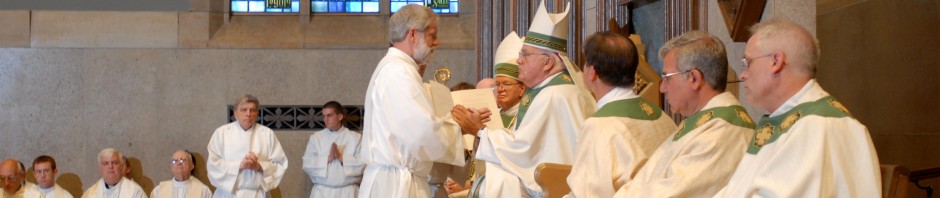
Deacon Bob Yerhot serves the diocese of Winona-Rochester, Minnesota. He has dedicated his life to the service of his family and the Catholic Church. He has studied philosophy, classical humanities, theology and social work at St. Mary’s College (now University) at Winona, Minnesota, the Pontifical Gregorian University in Rome, Italy, and the University of Minnesota, Minneapolis. He currently serves two parishes in southeast Minnesota, is the Assistant Director Emeritus of the Diaconate for the Diocese of Winona, and is the diocesan consultant for the Courage and Encourage Apostolate and Unbound ministry in the diocese. He offers days of reflection and retreats for diaconal communities in the United States. For over 30 years he practiced clinical social work and psychotherapy before retiring in 2015.
-
DISCLAIMER: The views expressed on this blog are mine alone and do not necessarily reflect the views of the Diocese of Winona-Rochester or any person or organization affiliated or doing business with the Diocese of Winona-Rochester. The views expressed are my own and should not be construed as reflecting the position of anyone else or any other entity. I strive to accurately express the teachings of the Roman Catholic Church when I post about such teachings. For definitive explanations of Church teachings, refer to your diocesan bishop and to the Catechism of the Catholic Church.
PATRON OF THIS WEBLOG – Pope John Paul I (Papa Luciani), also known as the “Smiling Pope,” the 262nd Successor of Peter, who reigned for 33 days in August – September 1978. Your Holiness, pray for us! We pray with you your fervent prayer: “Lord, take me as I am, with all my defects, my sins, and make of me what you desire.” Thank you for your simplicity and charity.
-
COPYRIGHT NOTICE – Every original writing that I post in my name remains my property. I retain copyrights. It may not be reprinted, reproduced or utilized without my direct permission or without clearly and evidently attributing it to me by name. If done electronically, a direct link to the original writing is required.
-
-
Recent Posts
Recent Comments
- Deacon Bob on Conferences and Retreats
- Tom Zeeh on Conferences and Retreats
- Deacon Bob on Deacon Bob’s Homilies — Click to Read
- Deacon Mike Hagen on Deacon Bob’s Homilies — Click to Read
- Deacon Bob on Holy Father’s Letter to the US Bishops on Retreat
Archives
- April 2024 (2)
- February 2024 (1)
- January 2024 (1)
- December 2023 (1)
- November 2023 (1)
- October 2023 (1)
- August 2023 (2)
- July 2023 (1)
- June 2023 (1)
- April 2023 (1)
- March 2023 (2)
- February 2023 (2)
- January 2023 (2)
- December 2022 (2)
- November 2022 (3)
- September 2022 (5)
- August 2022 (3)
- June 2022 (1)
- May 2022 (1)
- March 2022 (1)
- February 2022 (3)
- December 2021 (1)
- November 2021 (3)
- September 2021 (1)
- August 2021 (1)
- July 2021 (1)
- June 2021 (2)
- May 2021 (2)
- March 2021 (2)
- January 2021 (1)
- December 2020 (2)
- November 2020 (1)
- October 2020 (2)
- July 2020 (2)
- March 2020 (2)
- February 2020 (1)
- December 2019 (1)
- November 2019 (2)
- October 2019 (2)
- September 2019 (1)
- August 2019 (2)
- July 2019 (1)
- June 2019 (1)
- May 2019 (1)
- April 2019 (1)
- March 2019 (1)
- January 2019 (2)
- December 2018 (3)
- November 2018 (2)
- October 2018 (3)
- September 2018 (1)
- August 2018 (1)
- July 2018 (1)
- June 2018 (1)
- May 2018 (2)
- March 2018 (1)
- February 2018 (1)
- January 2018 (2)
- December 2017 (2)
- November 2017 (1)
- October 2017 (1)
- September 2017 (1)
- August 2017 (2)
- July 2017 (2)
- May 2017 (1)
- April 2017 (1)
- February 2017 (1)
- January 2017 (1)
- December 2016 (2)
- November 2016 (1)
- October 2016 (1)
- September 2016 (1)
- August 2016 (1)
- July 2016 (1)
- June 2016 (1)
- May 2016 (1)
- April 2016 (2)
- March 2016 (3)
- February 2016 (2)
- January 2016 (2)
- December 2015 (5)
- November 2015 (7)
- October 2015 (4)
- September 2015 (10)
- August 2015 (5)
- July 2015 (7)
- June 2015 (10)
- May 2015 (8)
- April 2015 (14)
- March 2015 (6)
- February 2015 (10)
- January 2015 (14)
- December 2014 (8)
- November 2014 (13)
- October 2014 (16)
- September 2014 (9)
- August 2014 (19)
- July 2014 (9)
- June 2014 (13)
- May 2014 (15)
- April 2014 (14)
- March 2014 (22)
- February 2014 (15)
- January 2014 (25)
- December 2013 (17)
- November 2013 (17)
- October 2013 (15)
- September 2013 (16)
- August 2013 (15)
- July 2013 (17)
- June 2013 (18)
- May 2013 (15)
- April 2013 (17)
- March 2013 (28)
- February 2013 (23)
- January 2013 (27)
- December 2012 (25)
- November 2012 (24)
- October 2012 (21)
- September 2012 (31)
- August 2012 (26)
- July 2012 (35)
- June 2012 (42)
- May 2012 (31)
- April 2012 (37)
- March 2012 (27)
- February 2012 (43)
- January 2012 (52)
- December 2011 (50)
- November 2011 (40)
- October 2011 (37)
- September 2011 (38)
- August 2011 (31)
- July 2011 (46)
- June 2011 (55)
- May 2011 (47)
- April 2011 (50)
- March 2011 (41)
- February 2011 (38)
- January 2011 (45)
- December 2010 (34)
- November 2010 (42)
- October 2010 (35)
- September 2010 (30)
- August 2010 (27)
- July 2010 (33)
- June 2010 (26)
- May 2010 (34)
- April 2010 (26)
- March 2010 (31)
- February 2010 (24)
- January 2010 (34)
- December 2009 (30)
- November 2009 (32)
- October 2009 (23)
- September 2009 (21)
- August 2009 (25)
- July 2009 (34)
- June 2009 (34)
- May 2009 (27)
- April 2009 (30)
- March 2009 (23)
- February 2009 (26)
- January 2009 (30)
- December 2008 (32)
- November 2008 (26)
- October 2008 (5)
Categories
Blogroll
Good Websites
- Catholic Culture
- Catholic News Agency
- Catholic News Service
- Catholics Come Home
- Culture of Life Foundation
- Daily Readings
- Diocese of Winona
- Fathers for Good
- Fides
- First Things
- For Your Marriage
- G.K. Chesterton
- L'Osservatore Romano
- Marriage: Unique for a Reason
- Minnesota Catholic Conference
- National Catholic Bioethics Center
- Papa Luciani
- Saint of the Day
- The Vatican
Subscribe
Meta
-

Category Archives: Papa Luciani (Pope John Paul I)
Papa Luciani on Pope Paul VI
As you may know, back last December Pope Benedict declared Pope Paul VI to be Venerable, i.e., he lived a life of heroic virtue. This is a first step toward canonization. There are many in the Church are saying many … Continue reading
Posted in Papa Luciani (Pope John Paul I), Popes
Comments Off on Papa Luciani on Pope Paul VI
Papa Luciani, Pope Benedict XVI and Vatican II
I saw with delight today in this video clip from the Catholic News Service the linking of Pope John Paul I with Pope Benedict’s understanding of the Second Vatican Council. In this video, Luciani is quoted as a young bishop … Continue reading
Posted in Church History, Ecclesiology, Papa Luciani (Pope John Paul I)
Comments Off on Papa Luciani, Pope Benedict XVI and Vatican II
Papa Luciani on the Catechism
Papa Luciani (Pope John Paul I) was noted for his catechetical manner of speaking to the people. It seemed as if each chance he had would be seized by him as an opportunity to catechize whoever happened to be listening. … Continue reading
Posted in Catechism of the Catholic Church, Papa Luciani (Pope John Paul I)
Comments Off on Papa Luciani on the Catechism
Papa Luciani: An Audio Tribute
Vatican Radio has put together a wonderful little audio report on the papacy of Pope John Paul I – Papa Luciani – in which you will hear him speaking in English, and you will be able to listen to the … Continue reading
Posted in Papa Luciani (Pope John Paul I), Popes
Comments Off on Papa Luciani: An Audio Tribute
Four Myths of Papa Luciani “Debunked”
John Allen, a correspondent from the National Catholic Reporter on November 2, 2012, wrote the following for that newspaper. Here are excerpts from the article. Oct. 17 marked the 100th anniversary of the birth of Albino Luciani, the man who … Continue reading
Posted in Papa Luciani (Pope John Paul I)
Comments Off on Four Myths of Papa Luciani “Debunked”
Albino Luciani – The Forgotten Pope
I would like to bring your attention to an article in America, an American Catholic periodical. Mo Guerin, who is writing a biography of Pope John Paul I – Papa Luciani – wrote an excellent article there on John Paul I as … Continue reading
Posted in Papa Luciani (Pope John Paul I)
Comments Off on Albino Luciani – The Forgotten Pope
Quote for the Day
“…There are usually two virtues to observe: justice and charity. But charity is the soul of justice. We must love our neighbour, the Lord recommended it so much. I always recommend not only great acts of charity, but little ones.” … Continue reading
Posted in Papa Luciani (Pope John Paul I), Virtues
Comments Off on Quote for the Day
Vatican Radio: Papa Luciani (Pope John Paul I)
A couple of days ago, the Vatican Radio did a piece on Papa Luciani, interviewing his niece Pia Luciani, and several others. Log on to this link to hear the radio broadcast: http://media01.radiovaticana.va/audiomp3/00339007.MP3 It is no secret to any of my … Continue reading
Posted in Papa Luciani (Pope John Paul I)
Comments Off on Vatican Radio: Papa Luciani (Pope John Paul I)
Commemorating the 100th Anniversary of Papa Luciani’s Birth
The Vatican City State is issuing a postage stamp commemorating the 100th anniversary of the birth of Albino Luciani, Pope John Paul I. Sorry I couldn’t get a better picture of it, but here is what I gleaned from … Continue reading
Posted in Papa Luciani (Pope John Paul I)
Comments Off on Commemorating the 100th Anniversary of Papa Luciani’s Birth
34 Years Ago Today, Papa Luciani Died
In the early morning hours of September 28, 1978, Pope John Paul I died in his sleep. I was in Wiesbaden, Germany at the time, and I remember waking up that day and one of the Army base women telling … Continue reading
Posted in Papa Luciani (Pope John Paul I)
Comments Off on 34 Years Ago Today, Papa Luciani Died
The Cause for Canonization of Pope John Paul I Moves Forward!
Pope John Paul I, the “smiling pope,” is pictured at the Vatican in 1978. (CNS/L’Osservatore Romano) The cause for the eventual canonization of Papa Luciani (Pope John Paul I) is moving forward! The official promoters of his cause met … Continue reading
Posted in Papa Luciani (Pope John Paul I)
Comments Off on The Cause for Canonization of Pope John Paul I Moves Forward!
34th Anniversary of Papa Luciani’s Election
Last Sunday, August 26th, was the 32nd anniversary of the election of Albino Luciani as Pope John Paul I. Because of numerous factors, I was unable until now to write a post in memory of this event. My readers are … Continue reading
Posted in Papa Luciani (Pope John Paul I)
Comments Off on 34th Anniversary of Papa Luciani’s Election
Cardinal Saraiva Martins optimistic about the beatification of Paul VI and John Paul I
Here is a video from RomeReports on the possible beatifications of John Paul I and Paul VI. (Can you tell I am excited?!) Click on this link to view.
Posted in Papa Luciani (Pope John Paul I)
Comments Off on Cardinal Saraiva Martins optimistic about the beatification of Paul VI and John Paul I
Papa Luciani to be Beatified Within the Year of Faith?
The Catholic News Agency a couple of weeks ago reported that it is quite possible the Pope Benedict will beatify Pope John Paul I (Papa Luciani) this upcoming year. For all of us who have been praying that Luciani’s holiness … Continue reading
Posted in Church News, Papa Luciani (Pope John Paul I)
1 Comment
Papa Luciani is One Step Closer
I was delighted to read in the Italian newspaper, Il Corriere Alpi that the cause of Pope John Paul I’s beatification and hopefully canonization is one step closer to fruition. According to the article, on October 17 this year, the official positio will … Continue reading
Posted in Papa Luciani (Pope John Paul I)
Comments Off on Papa Luciani is One Step Closer
