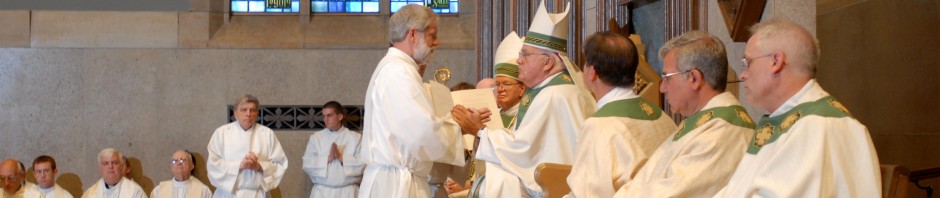
Deacon Bob Yerhot serves the Diocese of Winona-Rochester, Minnesota. He has dedicated his life to the service of his family and the Catholic Church. He has studied philosophy, classical humanities, theology and social work at St. Mary’s College (now University) at Winona, Minnesota, the Pontifical Gregorian University in Rome, Italy, and the University of Minnesota, Minneapolis. He currently serves two parishes in southeast Minnesota, is the Director of the Diaconate for the Diocese of Winona, and is the diocesan consultant for the Courage and Encourage Apostolate and Unbound ministry in the diocese. He offers days of reflection and retreats for diaconal communities in the United States. For over 30 years he practiced clinical social work and psychotherapy before retiring in 2015. He now is a spiritual director for clergy and men in formation.
-
DISCLAIMER: The views expressed on this blog are mine alone and do not necessarily reflect the views of the Diocese of Winona-Rochester or any person or organization affiliated or doing business with the Diocese of Winona-Rochester. The views expressed are my own and should not be construed as reflecting the position of anyone else or any other entity. I strive to accurately express the teachings of the Roman Catholic Church when I post about such teachings. For definitive explanations of Church teachings, refer to your diocesan bishop and to the Catechism of the Catholic Church.
PATRON OF THIS WEBLOG – Pope John Paul I (Papa Luciani), also known as the “Smiling Pope,” the 262nd Successor of Peter, who reigned for 33 days in August – September 1978. Your Holiness, pray for us! We pray with you your fervent prayer: “Lord, take me as I am, with all my defects, my sins, and make of me what you desire.” Thank you for your simplicity and charity.
-
COPYRIGHT NOTICE – Every original writing that I post in my name remains my property. I retain copyrights. It may not be reprinted, reproduced or utilized without my direct permission or without clearly and evidently attributing it to me by name. If done electronically, a direct link to the original writing is required.
-
-
Recent Posts
Recent Comments
- Deacon Scott on Thank You, Sioux City Deacons and Wives
- Deacon Bob on “I Identify as…..”
- karen querna on “I Identify as…..”
- Deacon Bob on Deacon Bob’s Homily for Thursday, 8th Week in Ordinary Time, Year I
- Gerarrad Majella on Deacon Bob’s Homily for Thursday, 8th Week in Ordinary Time, Year I
Archives
- June 2025 (2)
- March 2025 (1)
- February 2025 (1)
- December 2024 (1)
- November 2024 (1)
- October 2024 (1)
- September 2024 (1)
- August 2024 (1)
- June 2024 (1)
- May 2024 (1)
- April 2024 (2)
- February 2024 (1)
- January 2024 (1)
- December 2023 (1)
- November 2023 (1)
- October 2023 (1)
- August 2023 (2)
- July 2023 (1)
- June 2023 (1)
- April 2023 (1)
- March 2023 (2)
- February 2023 (2)
- January 2023 (2)
- December 2022 (2)
- November 2022 (3)
- September 2022 (5)
- August 2022 (3)
- June 2022 (1)
- May 2022 (1)
- March 2022 (1)
- February 2022 (3)
- December 2021 (1)
- November 2021 (3)
- September 2021 (1)
- August 2021 (1)
- July 2021 (1)
- June 2021 (2)
- May 2021 (2)
- March 2021 (2)
- January 2021 (1)
- December 2020 (2)
- November 2020 (1)
- October 2020 (2)
- July 2020 (2)
- March 2020 (2)
- February 2020 (1)
- December 2019 (1)
- November 2019 (2)
- October 2019 (2)
- September 2019 (1)
- August 2019 (2)
- July 2019 (1)
- June 2019 (1)
- May 2019 (1)
- April 2019 (1)
- March 2019 (1)
- January 2019 (2)
- December 2018 (3)
- November 2018 (2)
- October 2018 (3)
- September 2018 (1)
- August 2018 (1)
- July 2018 (1)
- June 2018 (1)
- May 2018 (2)
- March 2018 (1)
- February 2018 (1)
- January 2018 (2)
- December 2017 (2)
- November 2017 (1)
- October 2017 (1)
- September 2017 (1)
- August 2017 (2)
- July 2017 (2)
- May 2017 (1)
- April 2017 (1)
- February 2017 (1)
- January 2017 (1)
- December 2016 (2)
- November 2016 (1)
- October 2016 (1)
- September 2016 (1)
- August 2016 (1)
- July 2016 (1)
- June 2016 (1)
- May 2016 (1)
- April 2016 (2)
- March 2016 (3)
- February 2016 (2)
- January 2016 (2)
- December 2015 (5)
- November 2015 (7)
- October 2015 (4)
- September 2015 (10)
- August 2015 (5)
- July 2015 (7)
- June 2015 (10)
- May 2015 (8)
- April 2015 (14)
- March 2015 (6)
- February 2015 (10)
- January 2015 (14)
- December 2014 (8)
- November 2014 (13)
- October 2014 (16)
- September 2014 (9)
- August 2014 (19)
- July 2014 (9)
- June 2014 (13)
- May 2014 (15)
- April 2014 (14)
- March 2014 (22)
- February 2014 (15)
- January 2014 (25)
- December 2013 (17)
- November 2013 (17)
- October 2013 (15)
- September 2013 (16)
- August 2013 (15)
- July 2013 (17)
- June 2013 (18)
- May 2013 (15)
- April 2013 (17)
- March 2013 (28)
- February 2013 (23)
- January 2013 (27)
- December 2012 (25)
- November 2012 (24)
- October 2012 (21)
- September 2012 (31)
- August 2012 (26)
- July 2012 (35)
- June 2012 (42)
- May 2012 (31)
- April 2012 (37)
- March 2012 (27)
- February 2012 (43)
- January 2012 (52)
- December 2011 (50)
- November 2011 (40)
- October 2011 (37)
- September 2011 (38)
- August 2011 (31)
- July 2011 (46)
- June 2011 (55)
- May 2011 (47)
- April 2011 (50)
- March 2011 (41)
- February 2011 (38)
- January 2011 (45)
- December 2010 (34)
- November 2010 (42)
- October 2010 (35)
- September 2010 (30)
- August 2010 (27)
- July 2010 (33)
- June 2010 (26)
- May 2010 (34)
- April 2010 (26)
- March 2010 (31)
- February 2010 (24)
- January 2010 (34)
- December 2009 (30)
- November 2009 (32)
- October 2009 (23)
- September 2009 (21)
- August 2009 (25)
- July 2009 (34)
- June 2009 (34)
- May 2009 (27)
- April 2009 (30)
- March 2009 (23)
- February 2009 (26)
- January 2009 (30)
- December 2008 (32)
- November 2008 (26)
- October 2008 (5)
Categories
Blogroll
Good Websites
- Catholic Culture
- Catholic News Agency
- Catholics Come Home
- Culture of Life Foundation
- Daily Readings
- Diocese of Winona
- Fathers for Good
- Fides
- First Things
- For Your Marriage
- G.K. Chesterton
- Marriage: Unique for a Reason
- Minnesota Catholic Conference
- National Catholic Bioethics Center
- Saint of the Day
- The Vatican
Subscribe
July 2025 M T W T F S S 1 2 3 4 5 6 7 8 9 10 11 12 13 14 15 16 17 18 19 20 21 22 23 24 25 26 27 28 29 30 31 Meta
-

Category Archives: Fundamental Theology
What do YOU attribute to God?
In my homily for the early morning Mass today, in response to the Gospel in which Jesus is accused of casting out demons in the name of Beelzebub, I asked those present why it is so common for us to … Continue reading
Posted in Fundamental Theology, General Interest, homilies, Prayer and Meditation, Scripture, Spirituality
Comments Off on What do YOU attribute to God?
Why a Pope? Here’s the Answer.
I ‘d like to share with all of you a video produced by my diocese featuring the Director of Evangelization for the Diocese of Winona, Raymond DeSouza. As he always does with such clarity and eloquence, Mr. DeSouza speaks to … Continue reading
Posted in Dogmatic Theology, Ecclesiology, General Interest, Scripture
Comments Off on Why a Pope? Here’s the Answer.
Love God means Love Brother
The first reading at Mass today from John’s first epistle begins with the rather blunt statement, “Anyone who says they love God but hates his brother is a liar.” What a wonderful, I could say, expression of the reality of … Continue reading
Posted in Christology, Dogmatic Theology
Comments Off on Love God means Love Brother
The Politics of Muddy Thinking
One of my fellow bloggers, Deacon Scott Dodge in Salt Lake City, has written a wonderful post www.scottdodge.blogspot.com on the same-sex marriage issue that is threatening to engulf us all. I encourage you to link over and read it. Deacon Dodge … Continue reading
Posted in Ethics and Morality, Fundamental Theology, Homosexuality, Human Rights, Marriage and Family, Politics
Comments Off on The Politics of Muddy Thinking
The Kingdom of God is Among You
In today’s Gospel reading from Luke we hear Jesus proclaiming that the Kingdom of God is among us. He says that there will be men who will shout out, “He is here!” or “He is there!” but we are not … Continue reading
Posted in Ecclesiology, Fundamental Theology, Scripture
Comments Off on The Kingdom of God is Among You
“There is a Baptism with which I must be baptized…”
Today’s Gospel from Luke has Jesus declaring, “I have come to set the earth on fire, and how I wish it were already blazing! There is a baptism with which I must be baptized, and how great is my anguish … Continue reading
Posted in Dogmatic Theology, Sacraments, Scripture
Comments Off on “There is a Baptism with which I must be baptized…”
Pope Francis and the Devil
One of the things many people have noticed about Pope Francis right from the start is his reference to Satan. Many commentators have said this is a reflection of his Jesuit spirituality, and the charism of discernment often seen with … Continue reading
Posted in Dogmatic Theology, Pope Francis, Saints and Prophets, Spirituality
Comments Off on Pope Francis and the Devil
“And he kept trying to see him.”
Today’s Gospel passage from Luke is about how perplexed Herod became about the identity of Jesus. We hear of people telling him that Elijah has arisen, or the great prophet has come back. He immediately thought about John the Baptist, … Continue reading
Posted in Fundamental Theology, General Interest, Scripture
Comments Off on “And he kept trying to see him.”
Quote for the Day
“… Apart from this body, outside this unity of the Church in Christ, outside this Church… faith loses its ‘measure’; it no longer finds its equilibrium, the space needed to sustain itself.” — Pope Francis, Lumen Fidei, #22
Posted in Fundamental Theology, Pope Francis, Virtues
Comments Off on Quote for the Day
What’s piety got to do with it, got to do with it (sanctity)?
Tuesday evening I did something I swore in 2004 I would never do again: I watched Mel Gibson’s movie, The Passion of the Christ. All of it except for the scourging scene (it’s too graphic). When the movie came out, I, like … Continue reading
Posted in Fundamental Theology, Prayer and Meditation, Spirituality
Comments Off on What’s piety got to do with it, got to do with it (sanctity)?
Jesus and the Church are Inseparable
In follow up to my last post regarding salvation through Jesus Christ and the Church, I read this morning excerpts from Pope Francis’ homily for today, the memorial of St. George, the pope’s name day (Jorge translates George in English). … Continue reading
Posted in Dogmatic Theology, Ecclesiology
Comments Off on Jesus and the Church are Inseparable
The Trivialization of Evil and the Denial of a Good God
Benedict XVI wrote in his book, Jesus of Nazareth, “The idea that God allowed the forgiveness of guilt, the healing of man from within, to cost him the death of his Son has come to seem quite alien to us … Continue reading
Posted in Dogmatic Theology, Popes
Comments Off on The Trivialization of Evil and the Denial of a Good God
“It is Right and Just”
In the new translation of the Mass, one of our responses is, “It is right and just.” Many people find it a bit awkward to recite, clumsy, and not readily understood as to its meaning. What does “right and just” … Continue reading
Posted in Fundamental Theology
Comments Off on “It is Right and Just”
Quote for the Day
” But there is no true peace without truth! There cannot be true peace if everyone is his own criterion, if everyone can always claim exclusively his own rights, without at the same time caring for the good of others, of … Continue reading
Posted in Evangelization, Fundamental Theology, Pope Francis
Comments Off on Quote for the Day
Spiritual Blindness
It seems to me that in many ways, the Church and those who give witness to her teachings on important issues such as abortion, euthanasia, the dignity of marriage as the union of a man and a woman, the injustice … Continue reading
Posted in Fundamental Theology, General Interest, Spirituality
Comments Off on Spiritual Blindness
