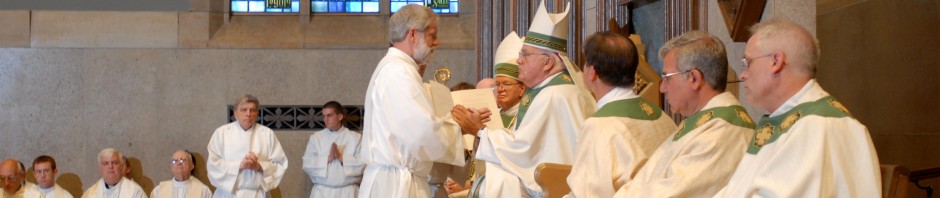
Deacon Bob Yerhot serves the Diocese of Winona-Rochester, Minnesota. He has dedicated his life to the service of his family and the Catholic Church. He has studied philosophy, classical humanities, theology and social work at St. Mary’s College (now University) at Winona, Minnesota, the Pontifical Gregorian University in Rome, Italy, and the University of Minnesota, Minneapolis. He currently serves two parishes in southeast Minnesota, is the Director of the Diaconate for the Diocese of Winona, and is the diocesan consultant for the Courage and Encourage Apostolate and Unbound ministry in the diocese. He offers days of reflection and retreats for diaconal communities in the United States. For over 30 years he practiced clinical social work and psychotherapy before retiring in 2015. He now is a spiritual director for clergy and men in formation.
-
DISCLAIMER: The views expressed on this blog are mine alone and do not necessarily reflect the views of the Diocese of Winona-Rochester or any person or organization affiliated or doing business with the Diocese of Winona-Rochester. The views expressed are my own and should not be construed as reflecting the position of anyone else or any other entity. I strive to accurately express the teachings of the Roman Catholic Church when I post about such teachings. For definitive explanations of Church teachings, refer to your diocesan bishop and to the Catechism of the Catholic Church.
PATRON OF THIS WEBLOG – Pope John Paul I (Papa Luciani), also known as the “Smiling Pope,” the 262nd Successor of Peter, who reigned for 33 days in August – September 1978. Your Holiness, pray for us! We pray with you your fervent prayer: “Lord, take me as I am, with all my defects, my sins, and make of me what you desire.” Thank you for your simplicity and charity.
-
COPYRIGHT NOTICE – Every original writing that I post in my name remains my property. I retain copyrights. It may not be reprinted, reproduced or utilized without my direct permission or without clearly and evidently attributing it to me by name. If done electronically, a direct link to the original writing is required.
-
-
Recent Posts
Recent Comments
- Deacon Scott on Thank You, Sioux City Deacons and Wives
- Deacon Bob on “I Identify as…..”
- karen querna on “I Identify as…..”
- Deacon Bob on Deacon Bob’s Homily for Thursday, 8th Week in Ordinary Time, Year I
- Gerarrad Majella on Deacon Bob’s Homily for Thursday, 8th Week in Ordinary Time, Year I
Archives
- June 2025 (2)
- March 2025 (1)
- February 2025 (1)
- December 2024 (1)
- November 2024 (1)
- October 2024 (1)
- September 2024 (1)
- August 2024 (1)
- June 2024 (1)
- May 2024 (1)
- April 2024 (2)
- February 2024 (1)
- January 2024 (1)
- December 2023 (1)
- November 2023 (1)
- October 2023 (1)
- August 2023 (2)
- July 2023 (1)
- June 2023 (1)
- April 2023 (1)
- March 2023 (2)
- February 2023 (2)
- January 2023 (2)
- December 2022 (2)
- November 2022 (3)
- September 2022 (5)
- August 2022 (3)
- June 2022 (1)
- May 2022 (1)
- March 2022 (1)
- February 2022 (3)
- December 2021 (1)
- November 2021 (3)
- September 2021 (1)
- August 2021 (1)
- July 2021 (1)
- June 2021 (2)
- May 2021 (2)
- March 2021 (2)
- January 2021 (1)
- December 2020 (2)
- November 2020 (1)
- October 2020 (2)
- July 2020 (2)
- March 2020 (2)
- February 2020 (1)
- December 2019 (1)
- November 2019 (2)
- October 2019 (2)
- September 2019 (1)
- August 2019 (2)
- July 2019 (1)
- June 2019 (1)
- May 2019 (1)
- April 2019 (1)
- March 2019 (1)
- January 2019 (2)
- December 2018 (3)
- November 2018 (2)
- October 2018 (3)
- September 2018 (1)
- August 2018 (1)
- July 2018 (1)
- June 2018 (1)
- May 2018 (2)
- March 2018 (1)
- February 2018 (1)
- January 2018 (2)
- December 2017 (2)
- November 2017 (1)
- October 2017 (1)
- September 2017 (1)
- August 2017 (2)
- July 2017 (2)
- May 2017 (1)
- April 2017 (1)
- February 2017 (1)
- January 2017 (1)
- December 2016 (2)
- November 2016 (1)
- October 2016 (1)
- September 2016 (1)
- August 2016 (1)
- July 2016 (1)
- June 2016 (1)
- May 2016 (1)
- April 2016 (2)
- March 2016 (3)
- February 2016 (2)
- January 2016 (2)
- December 2015 (5)
- November 2015 (7)
- October 2015 (4)
- September 2015 (10)
- August 2015 (5)
- July 2015 (7)
- June 2015 (10)
- May 2015 (8)
- April 2015 (14)
- March 2015 (6)
- February 2015 (10)
- January 2015 (14)
- December 2014 (8)
- November 2014 (13)
- October 2014 (16)
- September 2014 (9)
- August 2014 (19)
- July 2014 (9)
- June 2014 (13)
- May 2014 (15)
- April 2014 (14)
- March 2014 (22)
- February 2014 (15)
- January 2014 (25)
- December 2013 (17)
- November 2013 (17)
- October 2013 (15)
- September 2013 (16)
- August 2013 (15)
- July 2013 (17)
- June 2013 (18)
- May 2013 (15)
- April 2013 (17)
- March 2013 (28)
- February 2013 (23)
- January 2013 (27)
- December 2012 (25)
- November 2012 (24)
- October 2012 (21)
- September 2012 (31)
- August 2012 (26)
- July 2012 (35)
- June 2012 (42)
- May 2012 (31)
- April 2012 (37)
- March 2012 (27)
- February 2012 (43)
- January 2012 (52)
- December 2011 (50)
- November 2011 (40)
- October 2011 (37)
- September 2011 (38)
- August 2011 (31)
- July 2011 (46)
- June 2011 (55)
- May 2011 (47)
- April 2011 (50)
- March 2011 (41)
- February 2011 (38)
- January 2011 (45)
- December 2010 (34)
- November 2010 (42)
- October 2010 (35)
- September 2010 (30)
- August 2010 (27)
- July 2010 (33)
- June 2010 (26)
- May 2010 (34)
- April 2010 (26)
- March 2010 (31)
- February 2010 (24)
- January 2010 (34)
- December 2009 (30)
- November 2009 (32)
- October 2009 (23)
- September 2009 (21)
- August 2009 (25)
- July 2009 (34)
- June 2009 (34)
- May 2009 (27)
- April 2009 (30)
- March 2009 (23)
- February 2009 (26)
- January 2009 (30)
- December 2008 (32)
- November 2008 (26)
- October 2008 (5)
Categories
Blogroll
Good Websites
- Catholic Culture
- Catholic News Agency
- Catholics Come Home
- Culture of Life Foundation
- Daily Readings
- Diocese of Winona
- Fathers for Good
- Fides
- First Things
- For Your Marriage
- G.K. Chesterton
- Marriage: Unique for a Reason
- Minnesota Catholic Conference
- National Catholic Bioethics Center
- Saint of the Day
- The Vatican
Subscribe
July 2025 M T W T F S S 1 2 3 4 5 6 7 8 9 10 11 12 13 14 15 16 17 18 19 20 21 22 23 24 25 26 27 28 29 30 31 Meta
-

Category Archives: Virtues
Deacon Bob’s Homily for Divine Mercy Sunday
Divine Mercy Sunday April 6/7, 2024 Acts 4:32-35; 1 John 5:1-6; John 20:19-31 When I was growing up in the fifties and sixties, almost every Catholic home prominently displayed a painting of the Sacred Heart of Jesus and a crucifix … Continue reading
Posted in homilies, Spirituality, Virtues
Comments Off on Deacon Bob’s Homily for Divine Mercy Sunday
Deacon Bob’s Homily for the 31st Sunday in Ordinary Time, Cycle A
Here is my homily for this weekend. God bless you all! 31st Sunday in Ordinary Time, Cycle A Malachi 1:14b-2:2b, 8-10; 1Thes 2:7b-9,13; Matt 23:1-12 November 4/5, 2023 Both our first reading and Gospel today are all about humility and … Continue reading
Posted in homilies, Spirituality, Virtues
Comments Off on Deacon Bob’s Homily for the 31st Sunday in Ordinary Time, Cycle A
Deacon Bob’s Homily for Transfiguration Sunday, Cycle A
Transfiguration Sunday, Cycle A August 5/6, 2023 Daniel 7:9-10, 13-14; 2 Peter 1:16-19; Matthew 17:1-9 What glory there is in our hope! Hope will bring us to future glory. Our hope is in the cross of Christ. In today’s Gospel, … Continue reading
Fr. Frank Pavone, Archbishop Dolan, Final Report on Women Religious: My thoughts
I seldom post on current hot issues that have to do with specific persons. The last time I did, I got zillions of comments most which left me regretting the catalzying post at the time. Today, if you have been perusing … Continue reading
Posted in Ecclesiology, Religious Life, Virtues
Comments Off on Fr. Frank Pavone, Archbishop Dolan, Final Report on Women Religious: My thoughts
Quote for the Day
“Be kindly disposed toward the poor, the wretched and afflicted; help them as much as you can and console them.” — St. Louis IX, SFO
Posted in Saints and Prophets, Spirituality, Virtues
Comments Off on Quote for the Day
Chastity Wonderfully Conveyed
I ran across this YouTube video of a young couple speaking to a high school about chastity. From what I saw, no one has ever presented this with such clarity and in a manner so convincing. http://youtu.be/o34t3tdWrFo
Posted in Marriage and Family, Virtues
Comments Off on Chastity Wonderfully Conveyed
The Shrewdness of Subtle Pride
I occurred to me today, in a conversation I had with a man, how shrewd and subtle pride can be. I suppose you might shrug your shoulders and mutter, “So what’s new?” indicating that such an occurrence is well within … Continue reading
Posted in General Interest, Virtues
Comments Off on The Shrewdness of Subtle Pride
God’s Joy
What was the take home point, do you think, of the readings given us at Mass this Sunday? How did you receive them? As you recall, our first reading from the Old Testament was an account of Moses and God … Continue reading
Seeing God clearly, or through foggy lens?
This past week I was asked on two occasions to give the homily at daily Mass. I used the opportunity to reflect on the effect sin has on our ability to see the presence of God in daily life. The … Continue reading
Posted in Sacraments, Spirituality, Virtues
Comments Off on Seeing God clearly, or through foggy lens?
Quote for the Day
“… Apart from this body, outside this unity of the Church in Christ, outside this Church… faith loses its ‘measure’; it no longer finds its equilibrium, the space needed to sustain itself.” — Pope Francis, Lumen Fidei, #22
Posted in Fundamental Theology, Pope Francis, Virtues
Comments Off on Quote for the Day
Quote for the Day from Lumen Fidei, Francis’ First Encylical
Pope Francis’ first encyclical, Lumen Fidei, was released today and can be downloaded and read from the website of the Holy See (www.vatican.va). I am pouring over it this morning during an hour’s unexpected patient cancellation. On page 16 there is a … Continue reading
Posted in Pope Francis, Virtues
Comments Off on Quote for the Day from Lumen Fidei, Francis’ First Encylical
Pope Francis’ First Encyclical and the Completion of Luciani’s Catechesis
Pope Francis’ first encyclical, entitled Lumen Fidei, (The Light of Faith) will be released this Friday, 11 o’clock in the morning Rome time. There will be an English translation immediately available, so we excitedly anticipate its contents. I don’t know much about … Continue reading
Posted in Papa Luciani (Pope John Paul I), Pope Francis, Popes, Virtues
Comments Off on Pope Francis’ First Encyclical and the Completion of Luciani’s Catechesis
Quote for the Day
“…There are usually two virtues to observe: justice and charity. But charity is the soul of justice. We must love our neighbour, the Lord recommended it so much. I always recommend not only great acts of charity, but little ones.” … Continue reading
Posted in Papa Luciani (Pope John Paul I), Virtues
Comments Off on Quote for the Day
Quote for the Day
“We must live according to what we think, otherwise we end up thinking according to how we live” — Paul Bourget, in Le demon du midi (How true this is, dear readers! So many in our world today relegate right … Continue reading
Posted in General Interest, Virtues
Comments Off on Quote for the Day
What About the Joy?
One of my readers put the question to me in my last posting about diaconal suffering, “Is there not joy?” Joy is one of those human experiences that often gets confused with pleasure. Somehow in the minds of many, you … Continue reading
Posted in Spirituality, Virtues
Comments Off on What About the Joy?
